Why is the sky blue? Don't ask the AI for the answer, ask it for the experiment
A child's why gets answered by the AI in four seconds and forgotten in five. If instead of the answer you ask for a twenty-minute experiment with what is in the kitchen, your child discovers the answer, and that one sticks.
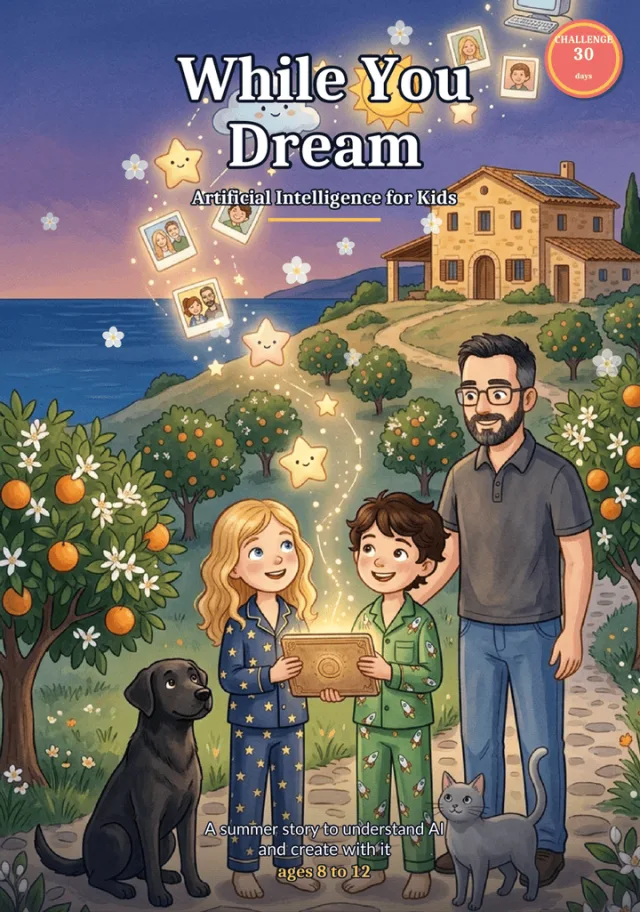 The book behind this articleWhile You Dreamfor children (8 to 12)
 Why is the sky blue? Why does a boat float and a stone sink? Why does the apple go brown? The questions arrive in the car, in the bath, at eight in the evening. And today the temptation is enormous: you ask the AI, read the answer out loud, done. The problem is not that the answer is bad. It is that an answer that cost nothing leaves as fast as it came.
The trick changes a single word in the question. Instead of asking the AI to explain, you ask it to design: a twenty-minute experiment with what is in the kitchen, so the child sees with their own eyes what the question is hiding. Before starting, the child writes down what they think will happen. Afterwards, you compare. That written prediction is half the method: it turns the child from spectator into scientist, and it makes the surprise, when it comes, theirs.
Five rules before the torch goes on
- An adult is always there, start to finish. The AI proposes, the adult decides whether it happens.
- No fire, no hob, no oven. If the experiment needs one, ask for a different experiment.
- Only what a kitchen holds: water, salt, sugar, vinegar, lemon, milk, oil, eggs, fruit. Nothing from the cleaning cupboard, no medicines.
- Nothing gets tasted because the AI says it can be tasted. What gets eaten is the adult's call.
- The adult reads the full instructions before the child starts, and if something looks off, it gets changed.
My child, aged [AGE], has just asked: [QUESTION]. I don't want you to give me the answer. I want you to design an experiment of about 20 minutes that we can do at home with ordinary kitchen materials, so my child can discover the answer for themselves. Conditions: no fire, no hob, no cleaning products or anything that isn't food, and an adult present. Give me: 1) the list of materials, 2) numbered steps in short sentences a child can read, 3) the prediction question I ask before we start, 4) what we should see, 5) the explanation in three sentences for afterwards, and 6) one new question that comes out of this experiment. If there is no safe kitchen experiment for this question, say so clearly and suggest a way to observe it in the real world instead.Three whys we have already tried
- Why is the sky blue? A clear jug of water, a torch and a few drops of milk, in a darkened room. Shine the torch through the water and add milk a drop at a time, stirring, until you can see the beam. Prediction: what colour will the light be from the side, and what colour at the far end of the jug? What you see: from the side the beam looks bluish; looking through the water towards the torch, it looks yellow to orange. The milk droplets scatter blue light more than red, just as the air does with sunlight: that is why the sky is blue and the sunset orange.
- Why does an egg float in salt water? Two glasses of water and one egg. In the first, the egg sinks. In the second, add salt a spoonful at a time, stir well, and test the egg again after each spoonful. Prediction: how many spoonfuls will it take? What you see: at some point the egg rises and stays up. Salt makes the water denser, and when the water is denser than the egg, the egg floats. It is the same reason you float more easily in the sea than in the pool.
- Why does the apple go brown? Three pieces of the same apple on three plates: one left alone, one dipped in lemon juice, one dipped in water. Wait fifteen to twenty minutes. Prediction: which one browns first? What you see: the untouched piece darkens, the lemon one barely changes. When the apple is cut, an enzyme in the fruit meets the oxygen in the air and makes the brown colour; the acid in the lemon slows that enzyme down. That is why fruit salad gets a squeeze of lemon.
The scientist's notebook
Question: Why does the egg float in salt water? What I think will happen: it will float after two spoonfuls. Materials: two glasses, water, salt, one egg, a spoon. What I did: added salt one spoonful at a time and tested each time. What I saw: at five spoonfuls it came up and stayed up. Was I right? No, it needed more than I thought. What I learned: salty water pushes up harder. My new question: does it float with sugar too?
There will be questions with no kitchen experiment, why is space black, why do cats purr, and the last point of the prompt is there on purpose: the AI has to say so rather than invent an experiment that doesn't work. Then the question goes in the notebook with a star and you find another way to look at it, a moonless night, a cat lying in the sun. We have written separately about making the most of the hour of whys with AI and about what to do when the AI gets it wrong.
Sources
- NASA Space Place: Why is the sky blue?
- Exploratorium: Blue Sky, the light, water and milk experiment
- Scientific American and Science Buddies: Salty Science, floating eggs in water
- Scientific American and Science Buddies: enzymatic browning in fruit
- The hour of whys: explore your children's questions with AI, While You Create
- When the AI gets it wrong, While You Create
- The leaf detective, While You Create
FAQ
Why should the child write the prediction down first?
Because it turns them from spectator into scientist. Writing down what they think will happen and comparing it afterwards with what they see makes the surprise theirs, and that is what sticks.
What materials do you need?
Only kitchen things: water, salt, sugar, vinegar, lemon, milk, oil, eggs, fruit and a torch. No fire, no hob, nothing from the cleaning cupboard and no medicines.
What if the experiment the AI proposes doesn't work?
It happens, because the AI gets quantities and steps wrong. The judge is the glass, not the chat: if the egg doesn't float, the child has won a new question, and you ask the AI to check its own steps.
What if the question has no kitchen experiment?
The prompt asks the AI to say so clearly instead of inventing one. The question goes in the notebook with a star and you find another way to observe it in the real world.
Did this article help you?