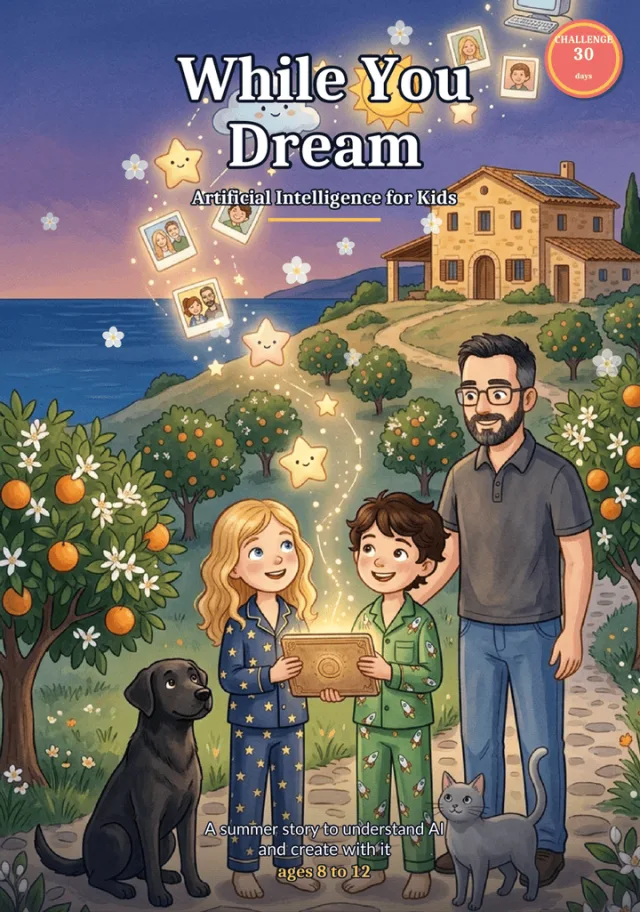
While You Create
An artificial intelligence book for parents
While You Sleep · for the whole family
An artificial intelligence book for parents: understand AI without jargon and guide your children, with a free companion site (80 prompts) and a 30-day challenge. On Kindle and paperback.
M. Henning · Updated September 9, 2026
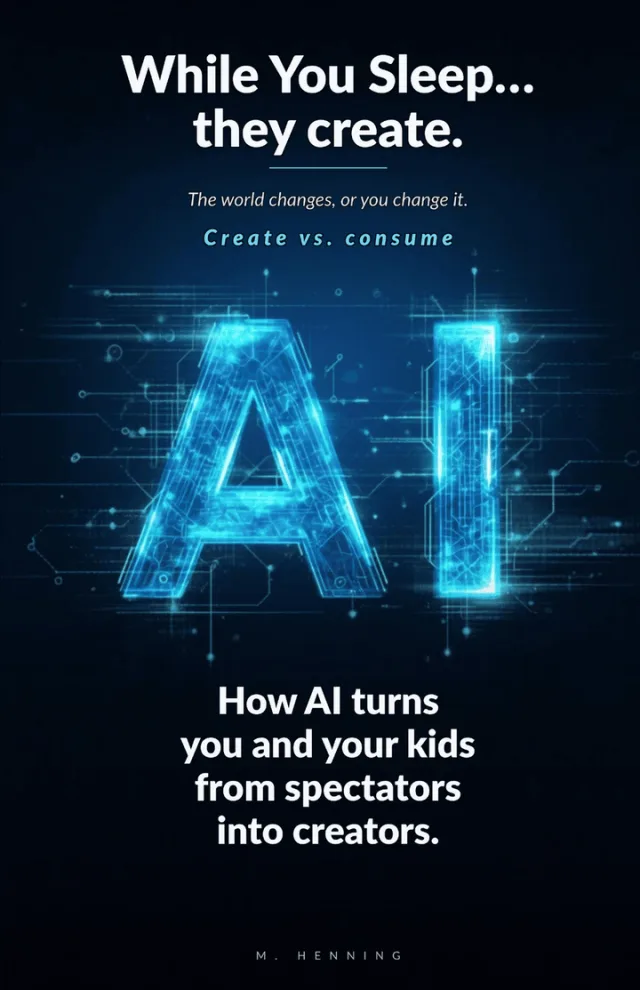
"While You Sleep" is an artificial intelligence book for parents who want to understand AI without jargon and guide their children while they use it. It is not a technical manual or a list of threats: it is a calm guide, meant to remove fear rather than add it, with the same approach as the whole series: create with AI instead of only consuming what others make with it.
It is written by M. Henning, author of the While You Create series. The book comes with a free companion site: over 80 ready-to-use prompts and a 30-day challenge. Available on Amazon: Kindle from $4.38 and paperback for $11.41.
What you take away from this book
- Understand AI without jargon: what ChatGPT or Gemini really do and do not do, explained with examples from home.
- Be there when your kids use it, instead of watching from outside without knowing what they are talking about.
- Set rules with judgment, not out of fear: what can be shared, what gets checked, when it is better to stop.
- Start creating with AI as a family: a story, an image, a small project made together.
What you'll find in the book
While you sleep, machines are creating. More than a billion people now talk with an artificial intelligence every week, and for the first time in history a single person can have the creative force of an entire team. This book is for the adults and families who feel, in some corner of their mind, that all of this scares them a little.
Calmly and without jargon, the author places that fear inside the long history of great technological leaps: the train, electricity, the telephone, the internet. Every time, the same fears, and almost every time, what came afterward was better for almost everyone. The difference today: AI does not extend the body, it extends the mind.
Twenty-four chapters and a toolbox, to understand AI without fear and learn, as a family, to create with it.
- Part I. Wake up
- Chapter 1: While you sleep…
- Chapter 2: Don't be afraid
- Chapter 3: We have lived through this before
- Part II. What it really is
- Chapter 4: What is this, really?
- Chapter 5: The agents that never sleep
- Chapter 6: What do the people building all of this want?
- Part III. The world that is coming
- Chapter 7: Abundance
- Chapter 8: If the machines work, what are we for?
- Chapter 9: The only limit is your imagination
- Part IV. Create, not consume
- Chapter 10: The two people who wake up
- Chapter 11: If it's free, you are the product
- Chapter 12: People like you
- Chapter 13: For children: playing is creating
- Chapter 14: Age by age: what to do, concretely
- Chapter 16: How to talk about it at home and at school
- Chapter 17: AI and your children, without fear
- Chapter 18: Learning to learn
- Chapter 19: For adults: the good idea
- Chapter 20: The most common mistakes (and how to avoid them)
- Chapter 21: Your first month: 30 small steps that change everything
- Chapter 22: The 30 day family challenge
- Chapter 23: The world will fill with noise
- Part V. Closing
- Chapter 24: Wake up
- Appendix: Your toolbox
- Appendix A: The dictionary without fear
- Appendix B: Which tool for what?
- Appendix C: The recipe for a good prompt
- Appendix D: Your collection of prompts
- Appendix E: When the AI doesn't understand you
- Appendix F: AI on your own computer
How do I teach my child to use AI?
Teaching works better than banning. A child who is shown how AI works, what to ask it and what to check, uses it with more judgment than one who is only told to keep away. The book suggests starting with what is already familiar to you (writing, drawing, planning something) and using AI as help to create it, not to do it all for you or for your child. That difference, between asking and creating, is the thread of the whole book.
Is it bad for my child to use ChatGPT?
No, if they use it to create and understand, and not just to copy answers without thinking them through. The book explains how to tell a use that helps (organising ideas, learning a topic, making a first draft) from one that replaces the effort entirely. It also gives concrete pointers for talking about it at home: what personal data they should never type, how to check whether something the AI told them is true, and why it helps to review what it produces together, at least at first.
When AI becomes their best friend
Some children and teens start talking to a chatbot as if it were a confidant, at any hour and about anything. The book gives this a section of its own: how to notice it without sounding the alarm, which questions open the conversation at home, and how to offer a real alternative, creating something together, rather than only banning the use. The company of a tool never replaces that of a family, but understanding why it appeals helps you get close in time. You can read a sample on the blog: a family code word for strange calls.
If the question underneath is what is still worth teaching, start here: what children should learn when AI already knows everything.
Where to get it
The book is on Amazon in two formats, Kindle and paperback. With the purchase, or even without it, you get access to the free companion site with the prompts, the no-jargon glossary and the 30-day challenge to start creating as a family.
Kindle
Paperback
Free companion site →30-day challenge →AI guide for families →
The three books in the series
One approach, create instead of consume, in three versions depending on who is reading.
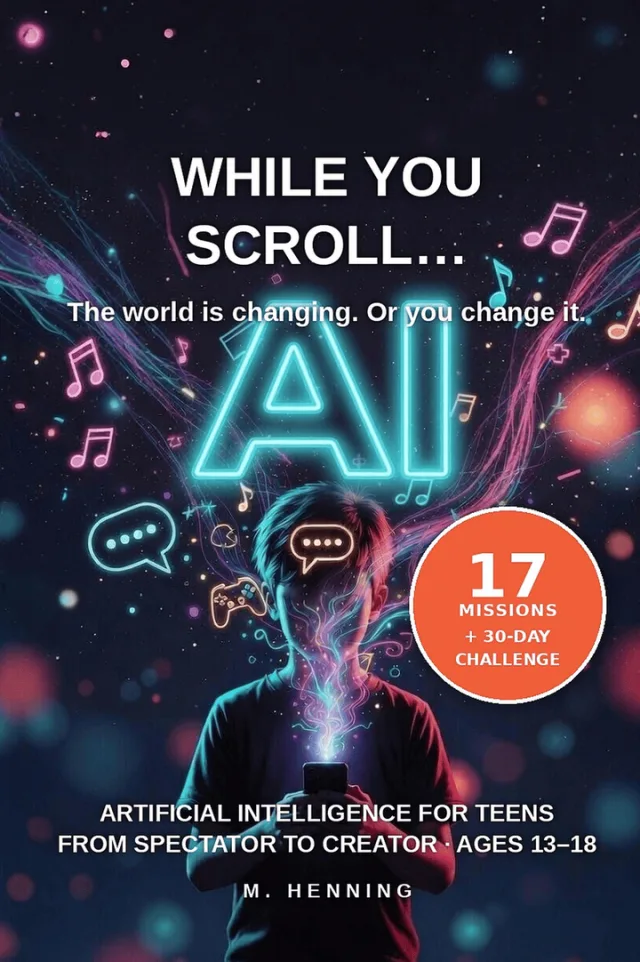
The whole series on WhileYouCreate.com
The site has the free companion pages for all three books, the downloadable material and the journal.
Go to WhileYouCreate.com →Learn AI as a family →Frequently asked questions
Do I need to know about technology?
No. The book is written without jargon, for parents who have never used an AI tool. It starts from zero.
Does it help whether my kids are young or teenagers?
Yes. The approach of understanding and guiding works at any age. If you want a book meant for your child to read directly, the series has one for kids aged 8 to 12 and one for teens aged 13 to 18.
Is it a technical book?
No. It is a practical, down-to-earth book without jargon, meant to be read in a couple of evenings and applied at home from the first chapter.
Do I need to pay for AI tools?
No. The free versions of ChatGPT, Grok or Gemini are enough for everything the book proposes.
How is it different from the other books in the series?
This is the one for parents and adults. "While You Dream" is for children aged 8 to 12 and "While You Scroll" for teens aged 13 to 18. All three share the same approach: create, do not just consume.