A summer explorer's logbook
A strange leaf, a shiny stone, a line of ants. With AI as expedition leader, summer walks turn into a real field notebook.
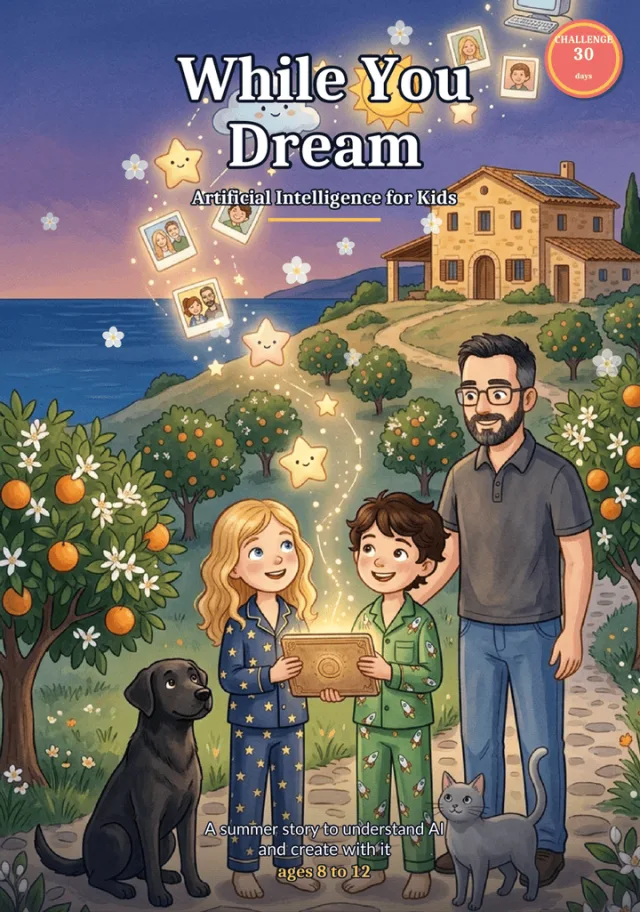 The book behind this articleWhile You Dreamfor children (8 to 12)
 Every kid comes back from the park with full pockets: a leaf with a strange shape, a stone that sparkles, the story of a line of ants carrying an enormous crumb. Most of the time, those treasures end up forgotten by the front door. The difference between walking and exploring is the same as between looking and writing down: an explorer keeps a logbook.
That is where the AI comes in, not as a magic identification machine, but as expedition leader. The kid describes the find in their own words, and the AI turns it into logbook pages with a fact file, an expedition title and a question for the next outing. What was a walk becomes Expedition number 4 of the club.
Copy this and adjust it
You are the expedition leader of an explorers club with an explorer aged [AGE]. I will describe what we find on each outing: leaves, stones, small creatures we watch without touching. First help us choose an explorer name and a name for the club. Then turn each description into a logbook page with this format: expedition title with date and place, a fact file of the find with the name we give it, where it was, what it looks like and what caught our eye, and one research question for the next outing. If a detail is missing, ask the explorer, one question at a time. Do not invent facts we have not told you.- Print each page and glue the real find next to it when you can, or a hand-drawn picture when you cannot: ants get drawn, not glued.
- Number the expeditions and give them a destination, even if it is the usual park: Expedition 7 to the Land of the Chestnut Trees sounds much better.
- At the end of the summer, ask the AI for an index and a back cover with the club's statistics: outings, finds, the hardest research question.
The important part still happens outside: crouching down, looking closely, describing things in your own words. The AI only puts a dress uniform on what the kid has already observed. And if one day nobody feels like doing the logbook, the expedition still counts.
FAQ
What if the AI misidentifies a leaf or a bug?
It will happen, and that is fine if you treat it as a hypothesis game: the AI proposes, the field guide or a knowledgeable adult confirms. The key thing is that identification never decides whether something gets touched or eaten: that answer is always no.
From what age does the logbook work?
From the moment a kid can describe what they see, roughly age four or five. Little ones dictate while an adult types; older kids can write their own fact file and use the AI only for the formatting.